
Rep. Ilhan Omar (D-MN) has told her life story many times. In her telling, she is a refugee child who fled civil war in Somalia, spent four years in a Kenyan camp and reached America with nothing.
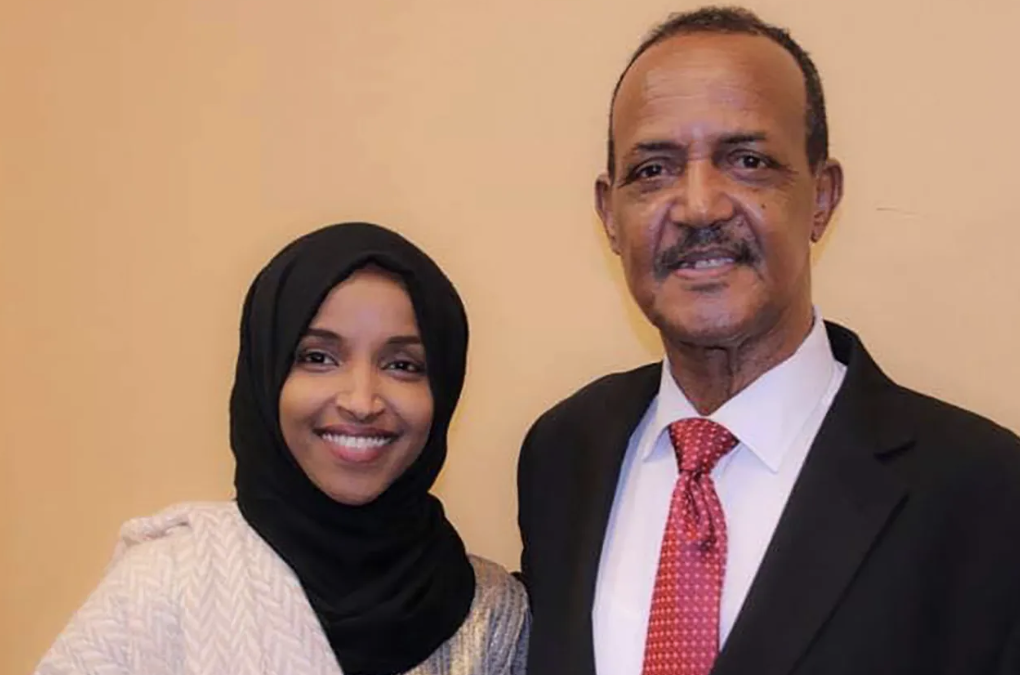
Her father, Nur Omar Mohamed, appears in that story as a gentle “educator.” The record shows something else. He was a colonel in the army of Mohamed Siad Barre, one of the most brutal dictators in modern African history.
That fact now carries legal weight. On October 12, federal agents searched Omar’s Washington home in a criminal probe of her family’s immigration paperwork. Who her father was, and what he told U.S. officials about himself, goes to the heart of that case.
An Educator in Uniform
Nur Omar Mohamed died of COVID-19 in Minneapolis in June 2020, at age 67. Sahan Journal, a Minnesota news site that serves the Somali community, published a warm obituary drawn from friends and former comrades.
It described a different man. He trained in the Soviet Union, joined the Somali National Army and rose to colonel. A fellow officer said he played “a significant role” in Somalia’s 1977-78 war against Ethiopia. His military career ended in 1991, when Barre fell. Snopes has since acknowledged the obituary’s account of his rank.
Mohamed Haji Ingiriis, an Oxford historian of the Somali civil war, goes further. In an interview reported by the Western Journal, he said Nur Omar Mohamed “was a military officer who was loyal to the regime until the end” and “misrepresented himself as a refugee.”
Twenty-One Years of Terror
To grasp what it meant to wear Barre’s uniform, a reader needs some history.
Somalia won independence in 1960. In 1969, army commander Mohamed Siad Barre seized power in a coup. He ruled for 21 years, first as a client of the Soviet Union and later of the United States.
Somalis belong to large clan families, and Barre ruled through them. He rewarded loyal clans and punished those he distrusted. His secret police, the National Security Service, became notorious for torture. A unit called the Red Berets carried out killings in the capital.
Bombing His Own Cities
The worst crimes fell on the Isaaq clan of the northwest, the region now called Somaliland. In 1988, after Isaaq rebels struck, Barre’s forces bombed the cities of Hargeisa and Burao from the air.
About 90 percent of Hargeisa was destroyed. More than 40,000 people died there, and the city became known as the “Dresden of Africa.” Estimates of the Isaaq dead from 1987 to 1989 run as high as 200,000.
A 2001 report commissioned by the United Nations concluded that “the crime of genocide was conceived, planned and perpetrated by the Somalia Government.” Somaliland has more than 200 known mass graves. In 2020, Somalia’s president apologized to the victims.
Massacre on the Beach
The killing was not confined to the north. In July 1989, unrest broke out in Mogadishu after Friday prayers. The U.S. State Department reported that military units detained about 2,000 people and “summarily executed at least 46 young men, mainly Isaaks, at a nearby beach.” One human rights group put the week’s death toll at 450.
In 1990, Red Berets shot dead more than 100 civilians at a soccer stadium in the capital. Human Rights Watch estimated that 50,000 to 60,000 people had died in the northern war by early 1990.
Barre’s cruelty reached the Omar family’s own clan, the Majerteen. After Majerteen officers attempted a coup in 1978, Barre purged them from the army and carried out reprisals that left about 2,000 dead. Nur Omar Mohamed kept his commission and served on.
The Day the Regime Fell
In January 1991, rebels of the United Somali Congress, drawn from the Hawiye clan, stormed Mogadishu. Barre fled the capital on January 27.
Revenge followed. Armed Hawiye gangs attacked Darod neighborhoods, the State Department reported. Barre was Darod. So are the Majerteen. Hundreds of thousands of Darod residents fled the city in what historian Lidwien Kapteijns calls “clan cleansing.”
The Omar family escaped to the Utange refugee camp in Kenya. In 1995 they reached the United States.
Refugees or Regime Loyalists?
The family did flee violence. The reason matters. They were not dissidents escaping a tyrant. They were the household of one of that tyrant’s senior officers, running from countrymen who had suffered under him.
National Legal and Policy Center (NLPC) believes Americans were sold a false picture. Omar may not have been a refugee in the sense most Americans understand the word. She may have been a family member of a despised political force that was lucky to escape the wrath of its own countrymen.
U.S. law does protect people who flee clan violence. It does not protect persecutors, and it does not reward people who lie about who they were.
Why the Paperwork Matters
Federal law denies asylum to anyone who “ordered, incited, assisted, or otherwise participated in the persecution” of others, as the Congressional Research Service explains. Membership in a brutal army is not enough by itself. Officials must ask what a person did and what he knew.
They cannot ask those questions about a colonel who presents himself as a teacher. That is why honesty on immigration forms counts.
The Supreme Court weighed a similar case in 2017. Divna Maslenjak, a Bosnian Serb, told U.S. officials her husband had avoided military service. In fact he had served as an officer in a brigade that took part in the genocide of Bosnian Muslims. The couple were deported. The Court held that prosecutors must show a lie “played some role” in winning citizenship.
Like Father, Like Daughter’s Citizenship
Omar’s case carries a twist. She says she became a citizen at 17 through her father’s naturalization in 2000. Investigators are asking whether she was 18, which would have required her own application.
Federal law adds another wrinkle. When a parent’s naturalization is revoked for fraud or concealment, a child who claimed citizenship through that parent loses it as well. Her father’s death in 2020 raises questions no court has yet answered.
Due Process and the Truth
Other Barre officials did find refuge here. Former Prime Minister Mohamed Ali Samantar lived in Virginia until Isaaq survivors sued him. In 2012 he accepted liability, and a court awarded $21 million. Lt. Col. Yusuf Abdi Ali, who commanded troops in the north, lived in Virginia for years before ICE deported him in 2024.
NLPC’s petition asks the Attorney General to review the files and begin deportation proceedings if Omar broke the law. Investigators now hold those files. The public deserves to learn what Nur Omar Mohamed told the government about his past, and whether it was true.


