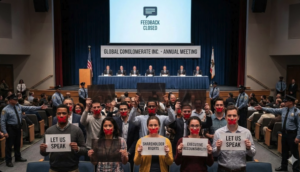
When the Securities and Exchange Commission set out to justify scrapping the rule that lets shareholders place proposals on corporate ballots, it quoted National Legal and Policy Center.
On Oct. 20, NLPC answered.
The quote came from a March interview with Reuters, in which NLPC’s Paul Chesser said companies “hate shareholder proposals” and will look for “some kind of minimally painful step” to persuade a sponsor to drop one. The agency cited the remark in its September plan to repeal the rule, which for more than eight decades has required public companies to include qualifying owner proposals in the materials investors use to vote.
NLPC’s comment letter (searchable version here) urges the SEC to keep the rule. A second letter (searchable version here) objects to a companion plan that would stop shareholders from posting their case on the agency’s public filing system. Below are four passages from the first letter, with context.
The SEC Used Our Words to Make a Point We Didn’t
The agency placed the Reuters quote inside a passage arguing that sponsors use proposals as leverage to win private deals, and that those deals show the process “has deviated from its original purpose.”
NLPC’s comment granted that companies prefer to settle. It rejected the rest:
Companies negotiate because a proposal brings a criticism into the open, and boards would rather address a criticism on their own terms than defend it before every owner. Each withdrawal NLPC has agreed to produced a change that applies to the whole company, or a disclosure available to every shareholder. None involved anything of value to NLPC. NLPC has never been party to such an agreement and never would be.
Atkins Invited Companies to Test His Theory, and None Did
Part of the SEC’s case rests on doubt about whether Delaware law, which governs most large U.S. companies, even allows shareholders to vote on advisory proposals.

Kyle Pinder
In October 2025, SEC Chairman Paul Atkins (pictured above) told a Delaware audience that Kyle Pinder, a partner at the Wilmington law firm Morris Nichols, had reached that conclusion in a yet-published paper. He invited companies to bring that claim to the SEC and said he had “high confidence” the staff would honor it. Five weeks later, the staff announced that for the 2025–26 season it would rule on that claim and no other.
The SEC chairman had put his agency’s weight behind one Delaware lawyer’s theory.
Companies had motive to pursue exclusion. In the prior season, they had asked the SEC to let them throw out about 370 proposals. NLPC’s submission recorded what happened next:
In July 2026, Chairman Atkins reported the result: “Much to my surprise, the Division did not receive a single request…”
Atkins made that admission in remarks to the Society for Corporate Governance, the trade group of corporate secretaries. Not one company was willing to stake its case on the theory his agency now cites to support repeal.
Most of the Cost Is Lawyers Hired to Fight
The SEC’s other main argument is expense. But in the survey the agency relies on, 57 percent of responding companies said more than half of what they spend on shareholder proposals goes to outside law firms, much of it for work to keep proposals off the ballot. NLPC followed the money:
What has grown is spending on lawyers. … Those fees buy exclusion arguments, opposition statements, and engagement strategy. None are needed to put a proposal on the ballot.
… A company that opposes a proposal has a cheaper course: print it, state its opposition, and let shareholders decide.
The “Niche” Concerns That Came True
Critics of the rule describe many owner proposals as narrow distractions. NLPC answered with its own record.
In 2024, NLPC urged Meta Platforms shareholders to back a proposal on a minimum age for social media, warning that state lawsuits over harm to children were “already destroying shareholder value.” Since then a New Mexico jury and judge have ordered Meta to pay a combined $942 million, and Meta settled with more than 40 state attorneys general for up to $17.1 billion.
It laid out similar warnings at General Motors and Starbucks, then drew the line:
A small proponent identified material risks in documents dated months or years ahead, and those risks then appeared in [company filings], court judgments, and congressional statements. Those are not niche concerns.
Companies Keep Their Microphone; Shareholders Lose Theirs
NLPC’s second letter took on a related SEC plan to bar shareholders from posting their reports on EDGAR, the agency’s public filing system, where investors and analysts track each company’s documents.
Procter & Gamble shows what that looks like. On Oct. 7, six days before its annual meeting, P&G posted a filing on EDGAR urging owners to reject NLPC’s proposal. NLPC’s report supporting the proposal could appear only on nlpc.org.
Under the SEC’s plan, that split becomes the norm at every company: management’s case disseminated to all subscribing investors on the SEC’s EDGAR platform, and the shareholder’s case wherever it can find room.
The Docket So Far Leans One Way
As of Oct. 22, NLPC’s comment was the only one on the public docket from a right-of-center organization. Most of the others were from church investment funds, pension funds, values-based money manager, left-leaning activists, and academics.
The SEC is accepting comments until Nov. 20.