Today, National Legal and Policy Center presented an “Adopt Cumulative Voting” proposal at the annual meeting of Mastercard Incorporated.
Board elections are usually conducted on a majority voting basis, and shareholders can only vote “yea” or “nay” for each member across the entire slate. That means that a coalition representing 51% of shareholders can effectively control 100% of board seats. Cumulative voting would allow investors to aggregate their votes so that representation would be proportional to ownership. In theory, if you own 50% of the company, you would get to elect 50% of the board.
Mastercard’s board opposed the proposal, as explained on page 110 of the company’s proxy statement. NLPC responded to the board’s opposition statement in an exempt solicitation report circulated to the company’s shareholders.
Presenting the proposal was Paul Chesser, director of NLPC’s Corporate Integrity Project. His three-minute remarks can be heard here, and a transcript follows:
I’m Paul Chesser of National Legal and Policy Center presenting Proposal 5, which asks the board to adopt cumulative voting in director elections.
This is a reform Mastercard needs to implement stronger accountability for directors to shareholders.
The company’s recent record reflects a board that converges easily and challenges itself rarely.
For example, Mastercard has committed corporate resources to politically charged initiatives.
It has also channeled philanthropic dollars to organizations well outside the political mainstream.
It joined a credit card-network effort to flag firearm purchases, then retreated under bipartisan criticism — leaving the company caught between conflicting state laws.
Most consequential for consideration of this reform step is China.
Mastercard built a domestic clearing joint venture with an entity tied to the People’s Bank of China.
The Company’s board chair has served for more than fifteen years on the international advisory council of China’s sovereign wealth fund.
A board chair with that profile is unlikely to challenge the company’s growing reliance on Chinese state infrastructure.
The public record contains no evidence that anyone on this board made such a challenge.
The board’s composition explains this pattern.
A clear majority of the directors come from a narrow range of professional and ideological backgrounds.
When everyone in the room shares the same assumptions, important questions go unasked.
Strong quarterly numbers do not change that.
The company’s largest-ever acquisition is now being unwound at a significant loss.
Cumulative voting can help address these conditions.
It allows shareholders to concentrate their votes behind a single nominee.
It gives a minority constituency a realistic path to one board seat.
It does not change majority control.
The Securities and Exchange Commission recognizes that it strengthens minority shareholders’ ability to elect a director.
Institutional Shareholder Services recommends voting in favor of proposals that provide it.
Mastercard’s board warns that cumulative voting could put a small group of shareholders in a position to elect a director who reflects their priorities.
With respect, this board is already aligned with particular priorities.
Proposal 5 does not impose any outcome.
It does not elect any director.
It simply preserves the possibility that a dissenting voice can be heard before the next costly decision.
That is a modest reform, and it is overdue.
I urge shareholders to vote FOR Proposal 5.
Thank you.
All assertions made by Chesser in his above remarks are footnoted and can be found in NLPC’s exempt solicitation report, here. An executive summary of the report can be viewed here.
Read NLPC’s shareholder proposal for the Mastercard annual meeting here.
Listen to Chesser’s presentation of the proposal at the meeting here.
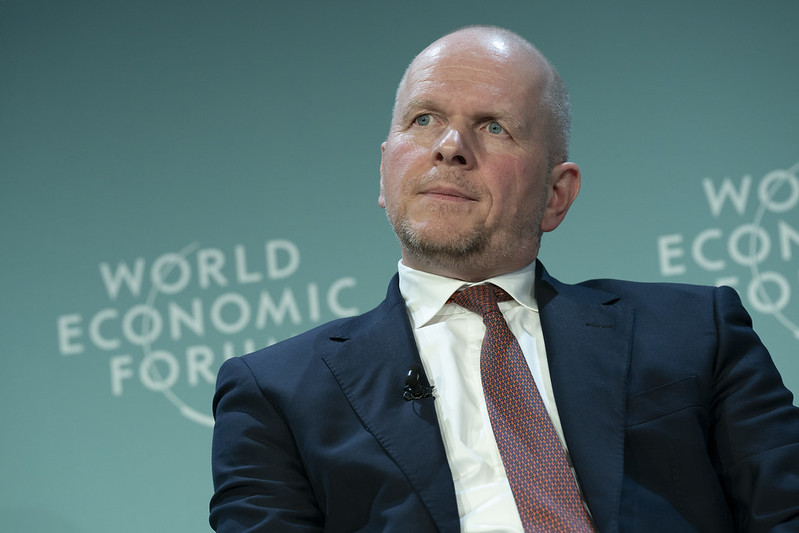
(Pictured above: Mastercard CEO Michael Miebach)